
Explanation of Common Used Incoterms: EXW, FOB, CFR, CIF, DPU, DDP
Incoterms, widely-used terms of sale, are a set of 11 internationally recognized rules which define the responsibilities of sellers and buyers. Incoterms specify who is responsible for paying for and managing the shipment, insurance, documentation, customs clearance, and other logistical activities.
Everyone who works with importation and exportation should know all the Incoterms (International Commercial Terms). It’s a very important subject that helps not only traders but lawyers, transporters and insurers.
Picture is from the Web
Commonly used international trade terms are: EXW: EX-Works FOB: Free On Board CIF: Cost, Insurance and Freight DDP: Delivered Duty Paid
-EXW (EX-Works)
Picture is from the Web
In the Ex Works contract, the buyer transports the goods from the seller's premises to the buyer's destination. The buyer is responsible for loading the goods for transportation, acquiring export and import licenses, getting security clearances, paying taxes and customs duties, unloading the goods at the destination, storing the goods at a warehouse at the destination, and all other costs and liabilities. The buyer is also responsible for insuring the goods while they are in transit. The only responsibility the seller has is to make sure that the goods are properly packaged and available for transport, and that all the documentation for customs and shipping are in correct order.
The buyer may request the seller to load the goods at the buyer's risk. If the buyer does not have the capability to complete the necessary export procedures or if the country does not allow foreign entities to do so, the buyer may request the seller to assist in getting export licenses and other documentation at the buyer's expense. Depending on local practice, the seller can load goods into transport vehicles if agreed by mutual parties. In other cases, where the buyer wants to avoid additional loading fees, the buyer arranges the loading with their own equipment or manually (i.e. loading of goods by hand). If the buyer is not able to clear customs on origin, it is recommended to use FCA Place of Receipt.
-FOB (Free ON Board)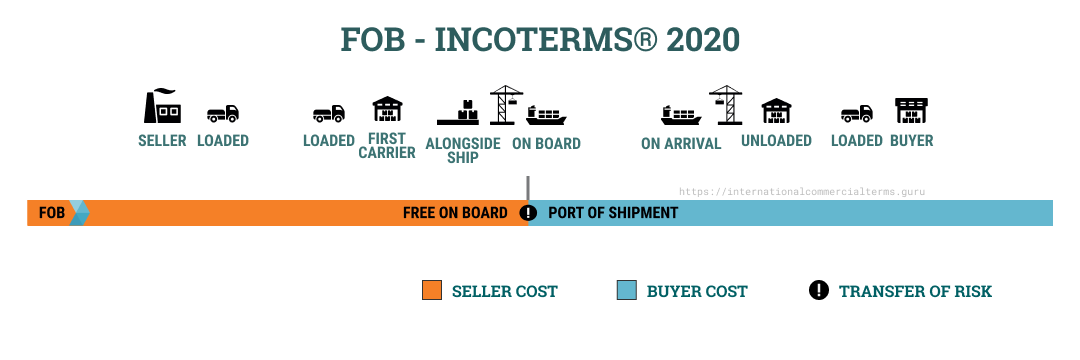
Picture is from the Web
The Incoterm FOB (Free On Board) applies to goods transported by ships and boats through seas, rivers, and canals. The seller is responsible for transporting the goods to the departure port and pays for all associated costs and risks. The seller acquires the necessary export permits and other documentation. The seller's responsibility ends after the goods have been loaded on to the vessel if the contract is Free on-board Shipping Point. The buyer assumes ownership and all liabilities for the goods. The buyer pays the freight costs and the insurance costs. If the contract is Free On-Board Destination, then the seller is liable and responsible for the goods until the destination port is reached. The buyer takes delivery of the goods at the destination port, and all responsibilities associated with the goods are then transferred from the seller to the buyer.
By using FOB the seller must clear the goods for export and delivers when the goods pass the ship’s rail at the agreed port. This term is only used for water transportation either sea or inland water. If both parties do not agree to have goods delivered on board, then FCA is the term to be used.
-CIF (Cost, Insurance and Frieght)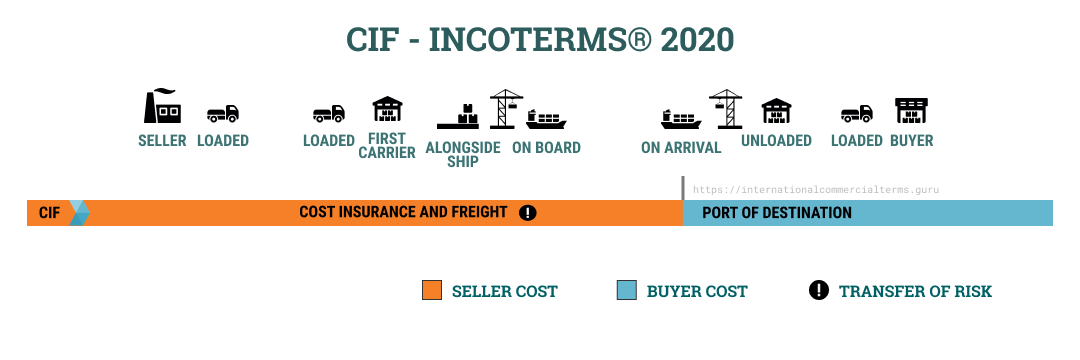
Picture is from the Web
CIF (Cost, Insurance, and Freight) is an Incoterm in which the seller is responsible for transporting the goods by sea or inland waterways to a destination port specified by the buyer. The seller pays all the transportation costs from the seller's premises to the departure port and then from the departure port to the destination port. The seller is responsible for procuring export licenses and other documentation and loading the goods on to the transport vessel.
Although most of the seller's liabilities end here, the seller still must cover the buyer's risk against loss or damage to the goods during transit and pay for insuring the goods. The CIF contract applies only to goods that are not transported in containers.
Along with paying the contract sale price, the buyer must acquire import licenses and any official authorizations and complete all necessary customs formalities and payment for importing and transporting the goods through different countries, if necessary, on the way to the end destination. The buyer will bear the risk of loss or damage to the goods once the goods are on the ship and will receive the goods when they are delivered at the end destination. The buyer will pay for the unloading of the goods at the final destination.
-DDP (Delivered Duty Paid)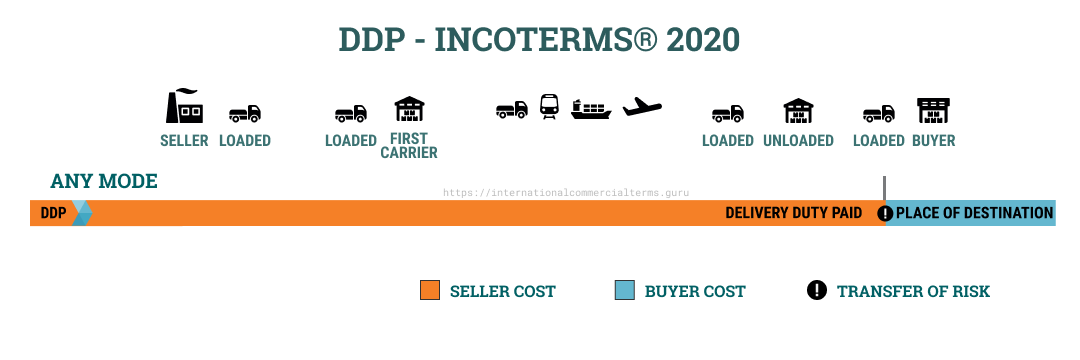
Picture is from the Web
According to the Incoterm Delivered Duty Paid or DDP, the responsibility for delivering the goods lies with the seller. Therefore, the seller must deliver the goods to the agreed upon destination at the agreed upon date and time and pay for all the costs associated with the delivery. The buyer should consider the fact that the price of the goods is determined by the charges incurred by the seller. The seller may transport the goods by road, railway, airway, or waterway and is liable for any loss or damage to the goods. If applicable, the seller may get some benefits in case of unforeseen circumstances from Contracts for the International Sale of Goods and other provisions.
The seller must get all necessary export and import clearances and pay any taxes and customs duties imposed on the goods. The seller must also arrange for the insurance for the goods in transit.
Two issues that the seller and buyer must consider are that in some countries only entities registered locally can pay taxes and in some countries, the laws may be so complex that the buyer is more likely to have expert knowledge of how to get import clearances and at lower costs too. If the buyer is paying the tax, then the contract is denoted as Delivered Duty Paid (tax unpaid), and in some cases, the buyer may be able to get tax benefits which can be passed on to the seller.
The seller must prepare all documentation such as sales contract, packaging and transport contracts, proof of delivery, and any other required documents. Once the goods are delivered to the destination, the buyer is responsible for unloading the goods and all other risks and responsibilities associated with the goods.
 Client onsite inspection | CAT 390FL excavator
 Client onsite inspection | Kubota U55 mini excavator
 Client onsite inspection | CAT 320D2L excavator
 Client onsite inspection | Hyundai R220 excavator


